Focusing on the frontiers of emerging technologies, it helps students gain an in-depth understanding of how technologies such as artificial intelligence and big data can drive business innovation, improve decision-making capabilities, and help enterprises gain a competitive advantage in a rapidly changing market.
This programme aims to nurture leaders with multiple perspectives, and through the integration of knowledge of business management and cutting-edge technology, students will master the theory and practice of multiple fields, and have the comprehensive ability to deal with complex business challenges.
The programme provides a wealth of international academic exchange opportunities, where students will interact with industry experts and scholars from around the world to share insights and experiences, broaden their horizons, promote cross-cultural understanding, and enhance their international competitiveness.
A strong support system consisting of school-program-alumni can provide students with a wealth of resources and opportunities, which is beneficial to students' career development.
Ph.D. in Computational Logic
Imperial College London, 1994
HKUST
Provost
Chair Professor
Department of Computer Science and Engineering
Department of Electronic and Computer Engineering
Fellow of the Hong Kong Academy of Engineering Sciences
Fellow of the Royal Academy of Engineering of the United Kingdom
Ph.D. in Finance
Yale University, 2009
HKUST
Associate Dean of Business and Management (Strategic Planning and Research)
Citi Professor of Business
Chair Professor
Department of Finance
Director of Institute for Financial Research
Ph.D. in Information Systems Management
Purdue University, 1988
HKUST
Vice-President for Administration and Business
Chair Professor
Department of Information Systems, Business Statistics and Operations Management
Acting Director of HKUST Institute for Emerging Market Studies
Associate Director of Institute for Financial Research
Ph.D. in Computational Logic
Imperial College London, 1994
HKUST
Provost
Chair Professor
Department of Computer Science and Engineering
Department of Electronic and Computer Engineering
Fellow of the Hong Kong Academy of Engineering Sciences
Fellow of the Royal Academy of Engineering of the United Kingdom
Ph.D. in Finance
Yale University, 2009
HKUST
Associate Dean of Business and Management (Strategic Planning and Research)
Citi Professor of Business
Chair Professor
Department of Finance
Director of Institute for Financial Research
Ph.D. in Information Systems Management
Purdue University, 1988
HKUST
Vice-President for Administration and Business
Chair Professor
Department of Information Systems, Business Statistics and Operations Management
Acting Director of HKUST Institute for Emerging Market Studies
Associate Director of Institute for Financial Research
Applicants should hold a master's degree.
This requirement ensures that the candidate has a strong grounding in business and management principles, which is essential for the advanced learning and research involved in the DBA program.
Work Experience
Applicants need at least 12 years of managerial experience.
Extensive work experience is a key component of the application, which demonstrates the applicant's ability to apply management theory and practice in a practical role.
Q&A
What are the admission requirements?
Applicants must possess the following:
Education: Applicants should hold a master's degree.
Work Experience: Applicants need at least 12 years of managerial experience.
For more information, please refer to "Application Requirements".
Who should enroll in this course?
The HKUST bilingual DBA program is designed for senior executives and entrepreneurs in Asia and the Greater China region who wish to pursue further studies in the academic field, and is committed to enhancing students' strategic thinking and leadership skills. Establish new horizons and open up new thinking in the ever-changing global business environment.
In which language is the course taught?
Courses are taught in Chinese or English, taught in Mandarin or English with Mandarin translation.
How often does this course take place?
Six study modules are planned for each academic year, each of which usually lasts four days (usually Thursday to Sunday). Some course schedules may vary depending on the elective course. For more information, please refer to "Mode of Instruction".
How do I prepare for an interview? Who will interview me? What is the application process?
The interview is divided into two parts: Chinese/English, of which the Chinese interview is in the form of a personal question and answer, and the English interview is in the form of a personal statement.
What if I don't have a master's degree? What if I have less than 12 years of work experience? Are there any cases of exceptional admissions?
Applicants will be screened based on their academic ability, education, work experience, and overall performance. Applicants who do not have a master's degree are required to attend supplementary courses and attend entrance examinations as required by the Programme Office, which are subject to the approval of the University Admission Committee. If the applicant has less than 12 years of work experience, it needs to be judged according to his or her work unit and job position. There is a quota for each year's approval, and the University Admissions Committee will screen applicants based on their overall quality.
HKUST's Areas of Excellence Scheme (AA) and Theme-based Research Scheme (TRS) 2024-25 achieved outstanding results and received the highest funding award among local institutions
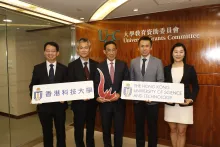
Three research projects led by the Hong Kong University of Science and Technology (HKUST) were awarded a total funding of HK$212.5 million by the Research Grants Council (RGC)’s Areas of Excellence (AoE) Scheme and the Theme-based Research Scheme (TRS) 2024/25, the highest funding amount among all local universities. It also marks a record-high result for the University.
HKUST held a forum in Singapore to promote collaboration in the field of family office and supply chain management between the two places
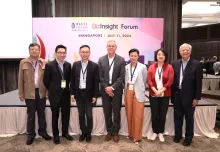
The School of Business and Management at The Hong Kong University of Science and Technology (HKUST Business School) yesterday hosted a forum in Singapore, uniting experts from academia and industries to delve into the vibrant development of the family office and supply chain management (SCM) sectors in the region. This forum aims to foster collaboration and uncover new opportunities in these pivotal industries, strengthening the ties between Hong Kong and the Lion City.
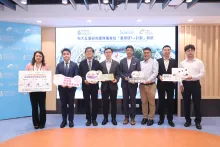
Five projects from The Hong Kong University of Science and Technology (HKUST) were among the first batch of 24 projects awarded funding under the “Research, Academic and Industry Sectors One-plus (RAISe+) Scheme” by the Innovation and Technology Commission of the Government. The new funding will help speed up commercialization of research discoveries that benefit the society, creating a win-win outcome among industry, academic, and research sectors. These research projects, led by professors at the HKUST School of Engineering and School of Science, cover a wide range of topics, including genome-editing, cancer tumor imaging, wastewater treatment, sensing chips, and artificial intelligence robots.
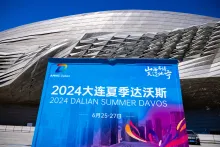
World Economic Forum's Summer Davos 2024 HKUST delegation inspires the world with innovations
AI technologies are poised to become more humanized in the art scene, according to Professor GUO Yike, HKUST Provost and world-renowned scholar on Artificial Intelligence (AI) and machine learning, who shared his thought leadership on the interplay of Generative AI and art at the World Economic Forum (WEF) Summer Davos 2024. Joining Professor Guo at the global event were Professor SHAO Minhua, Head and Chair Professor, Department of Chemical and Biological Engineering, and Professor FAN Zhiyong, Chair Professor, Department of Electronic and Computer Engineering — both of whom showcased innovations at this prestigious event— while Professor HUI Pan, Chair Professor of Computational Media and Arts of HKUST (GZ), participated as a member of Global Future Council on the Future of Metaverse.
HKUST President Attends the Annual Meeting of Presidents of the Pacific Rim University Alliance to Strengthen Inter-University Collaboration on Sustainable Development
The Hong Kong University of Science and Technology (HKUST) President Prof. Nancy IP attended the Association of Pacific Rim Universities (APRU) Annual Presidents’ Meeting at the University of Auckland from June 24-26. The three-day meeting gathered university leaders from APRU’s 61 member institutions to explore and exchange insights to tackle climate change challenges rippling through the Pacific Rim.
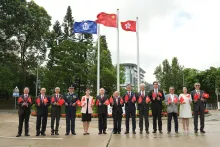
HKUST Holds Flag-Raising Ceremony to Celebrate the 27th Anniversary of Hong Kong's Return to the Motherland
HKUST and the Pacific Rim University Alliance (RAP) have joined hands to promote the development of a framework for the effective integration of AI in education
The Hong Kong University of Science and Technology (HKUST) collaborated with the Association of Pacific Rim Universities (APRU) to host the Foresight Workshop on campus from June 13-14, 2024. The event attracted over 40 international academic experts, key practitioners specialising in generative AI and education, university students, and education technology start-ups. Through a meticulous and collaborative process, various future scenarios were developed to provide members of the education industry with insights into the multifaceted opportunities and challenges that lie ahead in the realm of AI integration within higher education.
HKUST and HKUST (GZ) jointly launched the "Redbird Cross-Campus Learning Program"
The Hong Kong University of Science and Technology (HKUST) and the Hong Kong University of Science and Technology (Guangzhou) (HKUST(GZ)) jointly launched the "Redbird Cross Campus Study Program" today. The program will promote resource sharing and synergy between the two campuses under the “Unified HKUST, Complementary Campuses” framework, through mechanisms including course sharing, credit transfer and student exchanges in academics, research and social activities.
The Hong Kong University of Science and Technology (HKUST) gained recognition for its efforts to become a global sustainability leader as the University was ranked the world’s 36th, as well as the first in Hong Kong and Mainland China in its debut appearance in Times Higher Education (THE)’s Impact Rankings, announced in its annual Global Sustainable Development Congress (GSDC) yesterday in Bangkok.
Assessing over 2,100 universities worldwide for their impacts in helping achieve the United Nations’ 17 sustainable development goals (SDGs), THE commended HKUST in particular for its contributions to SDGs 9, 11 and 12, which focus on building resilient infrastructure and industries with innovation, promoting sustainable cities and ensuring responsible consumption and production.
Prof. WANG Yang, HKUST Vice-President for Institutional Advancement (VPIA), expressed delight for HKUST’s achievement in the Impact Rankings. “It is a testament to the University’s unwavering commitment to improving our living environment. The challenges we face today are getting more complex, requiring not only technology but also collaboration across institutions and disciplines to resolve them. As a breeding ground for innovation and technology, universities should spearhead joint initiatives to promote smart and sustainable development on a global scale,” he said.
To walk its talk, HKUST took the lead to invite top universities in joining a declaration to drive carbon neutrality by turning their campuses into living laboratories for innovations to achieve a sustainable future. A total of 15 universities from Asia, Europe, Oceania, North America and the Middle East made the pledge at the GSDC today. The living lab approach was inspired by a scheme implemented on HKUST campus a few years ago, which has funded 36 projects and ideas to date, including smart systems to reduce energy consumption and chemical wastage.
“Sustainability is a mindset. At HKUST, we have the mindset and vision to transform our campus into a net-zero living laboratory for experiential learning and research,” Prof. Wang added. “Sustainability also transcends borders and requires collaboration and shared knowledge. I hope this joint declaration, together with our other initiatives such as the Global Knowledge Network which promotes cross-border research work, can help generate more novel ideas and solutions for challenges such as climate change, water resource management, renewable energy or sustainable transportation.”
HKUST scholars also shared their insights on topics ranging from smart cities to solutions in fighting climate change at GSDC, which has attracted over 3,000 global thought leaders and innovators from 700 organizations around the world.
In a session on the development of early warning systems for extreme weather, Prof. Alexis LAU, Head of Division of Environment and Sustainability (ENVR) and Director of the Institute for the Environment at HKUST, Prof. CHEN Fei, Co-Chair of the Urban Prediction Project of World Meteorological Organization (WMO)’s World Weather Research Program and an ENVR Professor, along with Ms. Eva Yeung, Senior Manager of Community Resilience Service from Hong Kong Red Cross, discussed how personalized warnings tailored to vulnerable populations can help reduce live losses and damages amid extreme weather, and how scientists can work with humanitarian and non-profit-making organizations to disseminate the messages to the communities.
In another session, Prof. Hong LO, HKUST Dean of Engineering and Director of the GREAT Smart Cities Institute, elucidated the elements crucial for driving smart innovations in sustainable cities and communities, and how to address urban challenges and promote resource efficiency through the application of big data analytics and integrating technologies such as AI and Internet of Things (IoT).
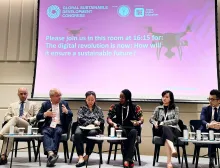
Meanwhile, Prof. Wang also exchanged insights in a panel discussion on how to drive a sustainable future amid the digital revolution with professionals such as an executive from Google and a ministerial commissioner from Hungary.
Committed to achieving net-zero carbon emissions by 2045, the University has implemented a range of initiatives over the years, including the “Sustainable Smart Campus as a Living Lab” in 2019. In 2020, HKUST installed one of the city's largest solar power systems, projected to reduce 1.5 million kg of carbon emissions annually over the next 25 years. More recently, the University poised to become the most EV-friendly campus in Hong Kong. With an investment of HK$40 million, it will upgrade 30% of its parking spaces with charging capability and related software support for electric vehicles.
HKUST jumped 13 places to join the world's top 50 universities
The Hong Kong University of Science and Technology (HKUST) is proud to announce that it has jumped 13 spots in the latest QS World University Rankings 2025, securing the 47th position among the world's top 50 universities. This is a recognition which affirms our dedication to excellence in teaching, research and knowledge transfer.